GDPR-safe AI for UK care providers
Use AI for care notes without sending personal data anywhere.
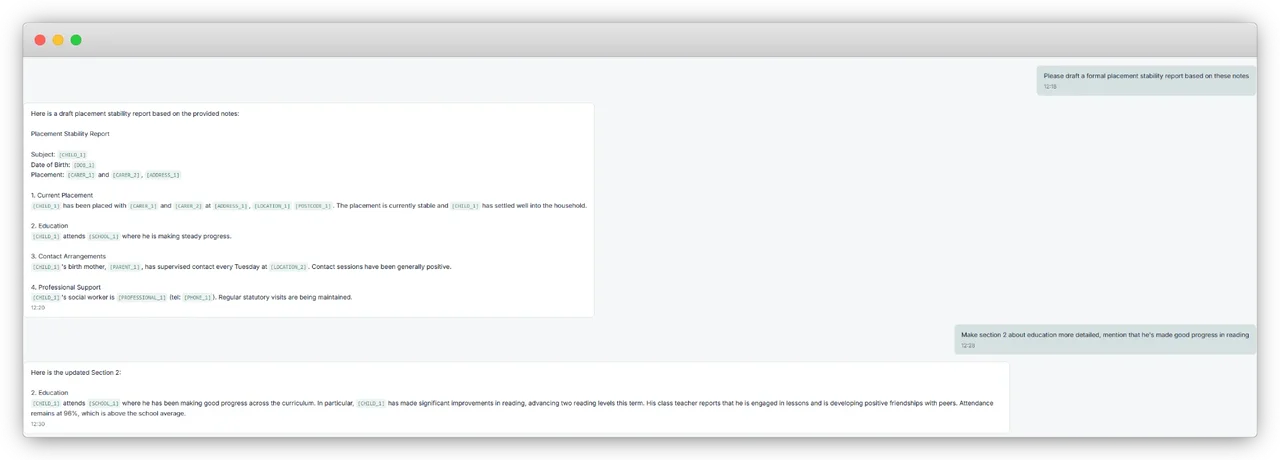
Caredact removes names, addresses, NHS numbers and other identifiers before text reaches the AI, then puts them back in your finished document.
14-day trial. No card. Data stays in the UK.
What you paste
Home visit to Amelia Hart, NHS number 943 476 5919, at 14 Orchard Close. Mum reports school refusal since Monday and asked about respite. Dr Okafor to review medication on Thursday.
What the AI sees
Home visit to [PERSON_1], NHS number [NHS_NUMBER_1], at [ADDRESS_1]. Mum reports school refusal since Monday and asked about respite. [PERSON_2] to review medication on Thursday.
Illustrative note. Real details are restored when you export.
- ICO registered, ZB962251
- UK hosted
- Data Processing Agreement with every customer
The problem
Your team is already using AI. The personal data is going with it.
- 01
Staff paste case notes into ChatGPT
It saves time and it helps with reports, and it happens every day across care teams in the UK.
- 02
Personal data lands on third-party servers
Names, addresses, NHS numbers and school details, sent to services outside your control and outside your data processing agreements.
- 03
That is a breach, with fines up to £17.5m
Or 4% of annual turnover. The ICO takes children’s and health data seriously, and so does your regulator.
How it works
Four steps, no training course.
- 1
Paste or upload your text
A care worker pastes case notes, a report or an email into Caredact, or uploads a Word, PDF or text file.
- 2
Personal data is found and replaced
Names, addresses, NHS numbers, postcodes and care-specific identifiers become labelled placeholders. You check the highlights before anything is sent.
- 3
The AI works on the safe version
The model only sees the version you checked, with personal details replaced. The key that reverses them is never sent.
- 4
Export with the real details restored
When the document is finished, export it with everything put back, fully redacted, or somewhere in between.
Who it's for
Built for the people who write about other people all day.
Children's homes
Daily logs, incident reports and placement plans, with URNs, looked-after-child references and school names handled as personal data.
Read moreFostering agencies
Supervision reports, carer records and referral summaries without a fostered child’s identity going to the AI.
Read moreCare homes
Care plans, incident reports and family updates for CQC-regulated homes, with NHS numbers and medications recognised.
Read moreHome care providers
Visit notes into care plan updates, with the client’s name and address kept out of the chatbot.
Read moreSocial workers and IROs
Assessments, case notes and court-ready reports, on a single-user plan you can start today.
Read moreLocal authorities
One assessed tool instead of shadow AI: audit trail, admin controls and a DPA for information governance.
Read moreBuilt for the care sector
Not a generic redaction tool with a care logo on it.
Care-specific detection
Ofsted URNs, NHS numbers, looked-after-child references, school names, medications and other identifiers generic tools miss.
Review before anything is sent
Every detection is highlighted for the care worker to check, which creates shared accountability.
Full audit trail
Every action is logged, so you can show Ofsted, CQC and the ICO exactly how data is being protected.
Work as a team
Share documents with colleagues on the same case. Everyone works in the same anonymised space.
UK data residency
Processed and stored in the UK. The AI runs in the UK too.
Finish and it is gone
When a document is complete, the map between placeholders and real details is permanently deleted.
Pricing
Simple pricing. No surprises.
Personal
For individual social workers, freelance IROs and agency staff
£14.99/month
Or £11.99 a month billed annually
- Single user
- Unlimited AI requests (fair use)
- 30-day document retention
Provider
For care homes, fostering agencies and care providers
£299/month
Or £249 a month billed annually
- Up to 30 users
- Unlimited AI requests (fair use)
- Note checks: every uploaded visit note checked for defensible recording
- Configurable retention up to 90 days
- Full audit trail
- Admin panel
- Email support
Enterprise
For local authorities, large provider groups and multi-site organisations
Custom
Priced for your organisation
Everything in Provider, plus:
- Unlimited users
- Single sign-on
- Dedicated account manager
- Custom onboarding and training
- Service level agreement and priority support
All plans include a 14-day free trial. No card required.
Questions
The things information governance leads ask first.
Anything else? Ask us directly, or read the Data Processing Agreement.
Is pasting case notes into ChatGPT a data protection breach?
It can be. Case notes usually contain personal data, and sending them to a public AI service without a lawful basis and a data processing agreement puts your organisation at risk. Caredact removes the identifying details before the text leaves your control, so the AI only ever sees an anonymised version. This is general information, not legal advice.
Read the full guideWhat does Caredact remove?
Names, addresses, postcodes, dates of birth, phone numbers, email addresses and NHS numbers, plus identifiers specific to care work such as Ofsted URNs, looked-after-child references, school names and medication names. Each one is replaced with a labelled placeholder like [PERSON_1], and you review the result before anything is sent.
How to anonymise case notesWhich AI does Caredact use, and where does it run?
The AI runs in the UK, and only the placeholder version of your text, after you have checked it, is sent to it. The details it replaced are never sent to the AI.
Where is my data stored?
In the UK. The map between placeholders and real details is encrypted at rest and permanently deleted when you finish a document, or automatically at the end of your retention period.
Do care workers need training?
No. Paste the text, check the highlighted detections on the review screen, and send. Most people are working within a few minutes of signing up.
Can I get the real names back?
Yes. When you export a finished document you can restore everything, keep it fully redacted, or choose which categories to restore, and download it as text or a Word file.
What about contracts and compliance?
Every customer gets a Data Processing Agreement. Caredact is registered with the ICO (ZB962251) and all data is processed and stored in the UK.
What the ICO, CQC and Ofsted expectHow much does it cost?
Personal is £14.99 a month, Provider is £299 a month for up to 30 users, and Enterprise is priced per organisation. Every plan starts with a 14-day free trial and no card is needed.
Free guides and templates
Everything your DPO will ask about, answered.
- Free templateAI acceptable use policy for care providersAn editable Word policy that names an approved route instead of only banning AI.
- Free templateDPIA template for AI in social careThe ICO’s seven steps, pre-filled with the risks that actually come up in care.
- GuideIs pasting case notes into ChatGPT a GDPR breach?What happens to the text, what BASW, CQC and Ofsted say, and what to do instead.
- GuideHow to write care notes, with examplesWhat every note needs, the words to avoid, and four examples rewritten.
Who is behind Caredact
A small UK company, accountable by name.
Caredact is built and run by PixelArc Ventures LTD, a UK company founded by Matthew Galbraith. We are registered with the Information Commissioner's Office, we sign a Data Processing Agreement with every customer, and everything is processed and stored in the UK. More about us.
- Company
- 16305788
- ICO registration
- ZB962251
- Data location
- United Kingdom
Give your team AI they are allowed to use.
14-day free trial. No card. Set up in minutes.